3D Printed Jewelry: A Complete Beginner's Guide
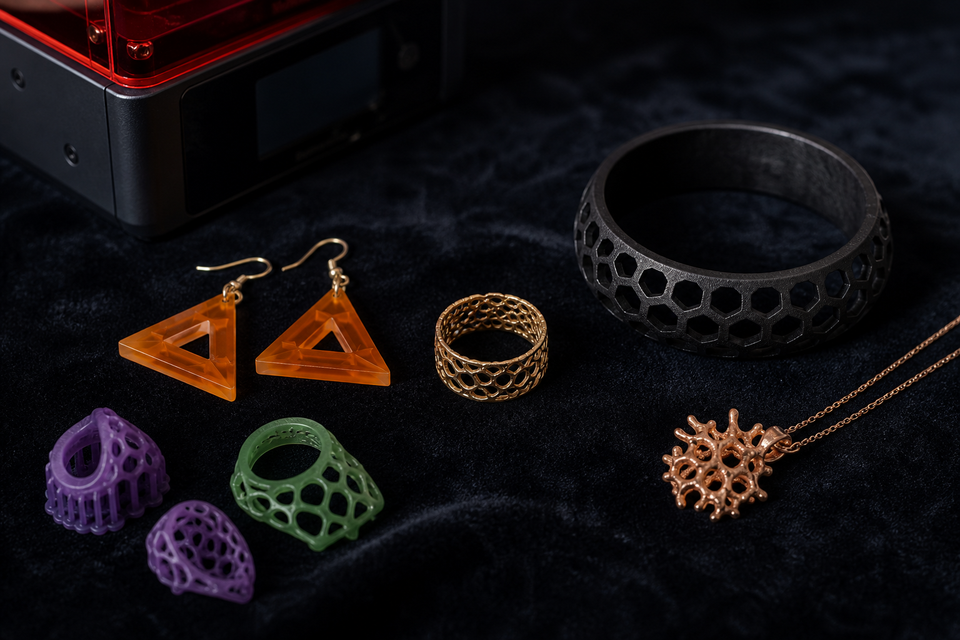
3D printed jewelry is one of the fastest-growing segments in both the maker community and the fine jewelry industry. What started as a niche experiment in high-end design studios has become accessible to anyone with a $300 resin printer and a free weekend.
The concept is simple: instead of hand-carving a piece of jewelry from wax or metal, you design it digitally and let a 3D printer produce it. The result can be a wearable resin piece, a pattern ready for gold casting, or even a direct metal print worth thousands of dollars.
Whether you want to design custom engagement rings, sell handmade earrings online, or simply understand how this technology works, this guide covers everything from the professional casting workflow to simple DIY methods you can try at home tonight.
How Is 3D Printed Jewelry Made?
There are two fundamentally different approaches to 3d printing jewelry, and understanding the distinction will save you a lot of confusion when researching this topic.
The Lost-Wax Casting Method (How Professionals Do It)
This is the industry-standard method used by jewelers worldwide. The final product is real gold, silver, or platinum. The 3D printer only creates the pattern, not the actual jewelry.
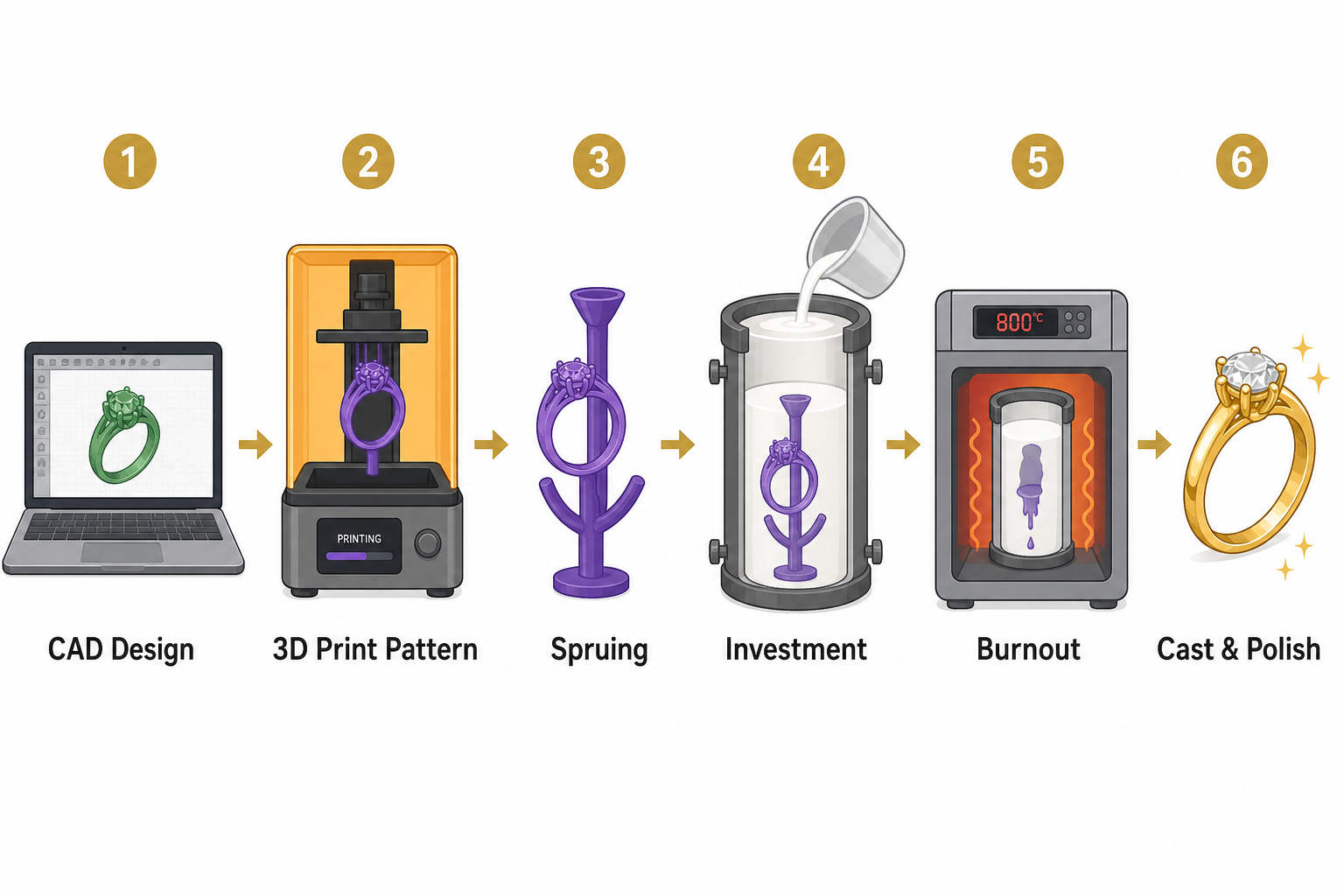
Here is the workflow:
- CAD Design: A jeweler designs the piece in specialized software (RhinoGold, MatrixGold, or Blender).
- 3D Print the Pattern: A resin printer produces an ultra-detailed model using castable wax resin. This material is designed to burn away cleanly at high temperatures.
- Spruing: The printed piece is attached to a wax "tree" that creates channels for molten metal to flow.
- Investment: The tree is encased in plaster inside a steel flask.
- Burnout: The flask goes into a kiln at 700+ degrees Celsius. The resin/wax melts and burns away completely, leaving a perfect hollow cavity in the plaster.
- Casting: Molten gold, silver, or platinum is poured (or vacuum-pulled) into the cavity.
- Finishing: The raw metal piece is cut from the tree, filed, polished, and stones are set.
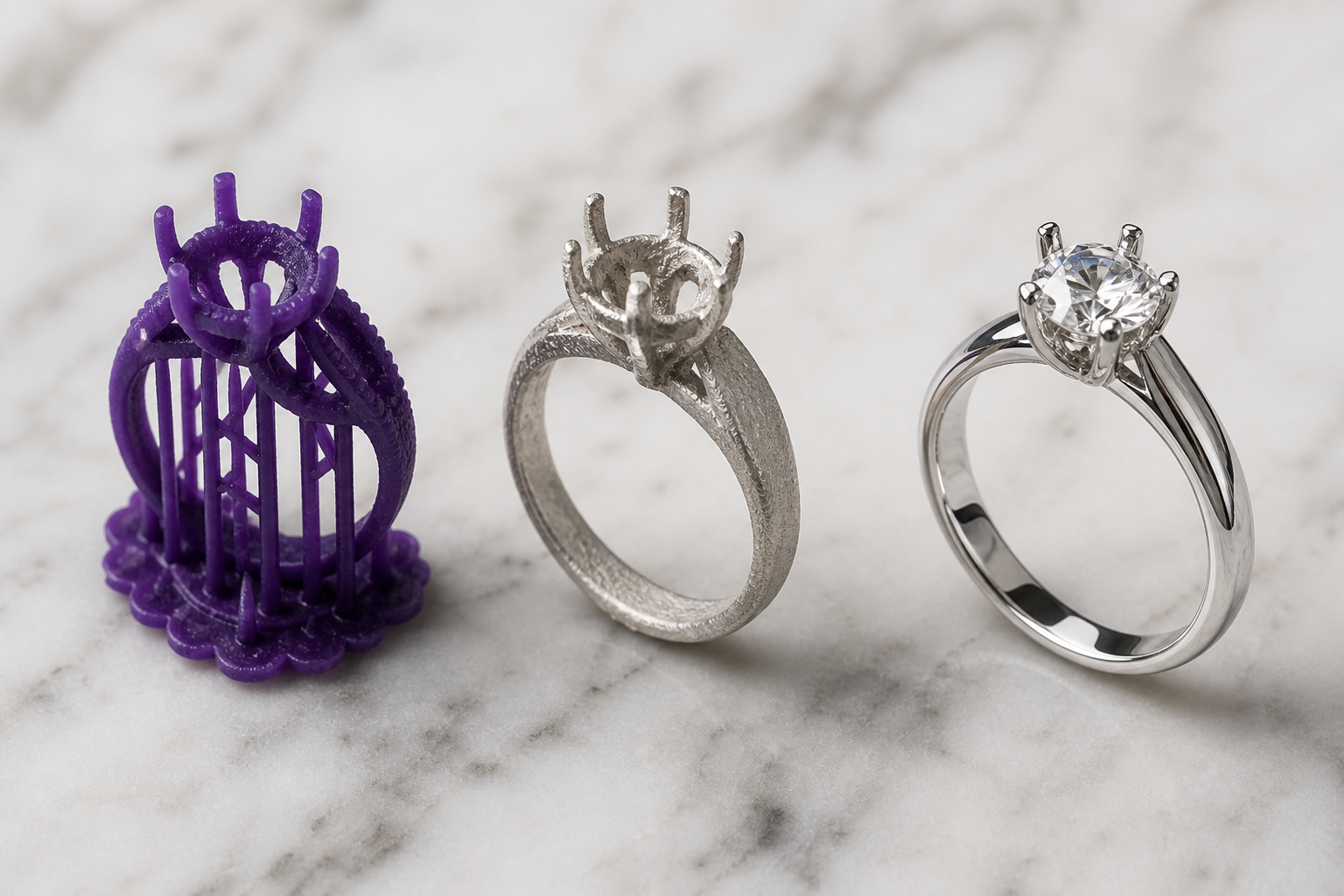
The key to this method is using a 3d printer for jewelry casting specifically designed for clean burnout. Standard resin expands when heated and leaves carbon ash that ruins the metal surface. Castable wax resins (like Formlabs Castable Wax, Siraya Tech Cast, or Phrozen Wax-like) contain real wax content that melts away without residue.
Direct Wearable Prints (No Casting Required)
Not all 3D printed jewellery needs to go through a metal casting process. Many makers create pieces that are worn directly as printed, with no metalwork involved.
Resin jewelry (most popular for direct wear):
- Translucent earrings, pendants, and statement rings
- Printed on consumer resin printers ($200-500)
- Post-processed with sanding, polishing, and clear coat
- Lightweight, colorful, and perfect for fashion/costume jewelry
FDM jewelry (budget-friendly, bold designs):
- Chunky bangles, geometric pendants, large earrings
- Printed with metallic or silk PLA filament for a premium look
- Can be sanded and painted for professional-looking results
- Best for oversized statement pieces where fine detail is less critical
Electroplated prints (plastic core, metal surface):
- Print in resin or PLA, then electroplate with copper, nickel, or gold
- Results look and feel like solid metal at a fraction of the weight and cost
- Popular for costume jewelry brands selling on Etsy
What 3D Printers Do Jewelers Use?
The answer depends on your budget and goals. Here is how the hardware landscape breaks down:
Resin Printers for Fine Jewelry (SLA/DLP/LCD)
These are the workhorses of the 3d printer for jewelry industry. Resin printers cure liquid photopolymer layer by layer, achieving detail as fine as 25 microns (0.025mm), enough to reproduce delicate filigree, micro-pave stone settings, and thin prong structures.
Professional tier ($2,000-5,000):
Printer | Resolution | Build Volume | Best For |
|---|---|---|---|
Formlabs Form 4 | 50 micron XY | 200x125x210mm | Industry standard, huge material library |
Phrozen Sonic Mega 8K | 28.5 micron XY | 330x185x400mm | Large batch production |
SprintRay Pro 55S | 49 micron XY | 192x120x200mm | Fast printing, dental/jewelry crossover |
The Formlabs jewelry 3d printer (Form 4) deserves special mention: it is the most widely referenced machine in professional jewelry forums and workshops due to its reliability, dedicated castable resins, and extensive support documentation. If budget is not a constraint, it is the safe choice.
Hobbyist/Small studio tier ($200-800):
Printer | Resolution | Build Volume | Best For |
|---|---|---|---|
Elegoo Saturn 4 Ultra | 19 micron XY | 218x123x260mm | Best value for fine detail |
Phrozen Sonic Mini 8K | 22 micron XY | 165x72x180mm | Ultra-detail, compact |
Anycubic Photon Mono M7 | 24 micron XY | 219x123x250mm | Budget-friendly, good community |
For most beginners exploring 3d jewelry design as a hobby or side business, an $300-500 LCD resin printer paired with a $30-50 bottle of castable resin is enough to produce professional-quality patterns.
FDM Printers for Costume Jewelry
Any FDM printer (Bambu Lab A1 Mini, Creality Ender 3 V3, etc.) can produce chunky, bold jewelry. The resolution is lower (100-200 micron layer lines are visible), but for oversized statement pieces, bangles, and decorative items, this is perfectly acceptable.
Best filaments for FDM jewelry:
- Silk PLA (metallic gold/silver/copper sheen)
- Bronze-fill or copper-fill PLA (contains real metal powder, can be polished)
- Translucent PETG (glass-like look for pendants)
Direct Metal Printers (Industrial Scale)
Technologies like DMLS (Direct Metal Laser Sintering) and SLM can print directly in gold, silver, platinum, and titanium. These machines cost $100,000 to $500,000+ and are used by large manufacturers and jewelry houses for production runs.
For consumers, this means you can order direct metal prints through services (covered below) without owning the machine yourself.
How to Make 3D Printed Jewelry at Home
You do not need a professional studio to start. Here are three methods ranked from simplest to most involved:
Method 1: Print Resin Jewelry You Can Wear Directly
What you need: A consumer LCD resin printer ($200-500), standard or plant-based resin, sandpaper, clear coat spray.
Process:
- Download or design a ring, earring, or pendant model
- Print at the highest resolution your printer supports (use 25-35 micron layers)
- Wash in isopropyl alcohol and fully cure under UV light
- Sand smooth starting at 400 grit, work up to 1500-2000 grit
- Apply 2-3 coats of clear lacquer or jewelry-grade UV resin for a glossy finish
- Attach earring hooks, jump rings, or chain as needed
Best for: Earrings, pendants, brooches, decorative hair clips. Rings work too, but resin is more fragile than metal for thin bands.
Method 2: Print with Metallic Filament on Any FDM Printer
What you need: Any FDM 3D printer, metallic/silk PLA filament (~$25/spool), sandpaper, primer, metallic spray paint (optional).
Process:
- Choose or design a bold, chunky jewelry model (minimum 2mm wall thickness)
- Print with silk gold/silver/copper PLA at 0.1mm layer height
- Sand and prime if you want a completely smooth finish
- Optional: spray with metallic paint or electroplate for a real metal surface
Best for: Bangles, cuffs, large statement rings, geometric pendant designs, costume pieces.
Method 3: Print Castable Patterns and Use a Casting Service
What you need: A resin printer ($200-500), castable wax resin (~$50/bottle), access to a casting service.
Process:
- Design or download your jewelry model (exported as an STL file)
- Print in castable resin at maximum detail
- Clean and fully cure the printed pattern
- Ship the pattern to a casting service (search "jewelry casting service" locally, or use online services like Shapeways or CastingHouse)
- Choose your metal (sterling silver: ~$30-50/piece, 14K gold: ~$150-400/piece)
- Receive your finished, real-metal piece in 1-3 weeks
This is the most affordable path to owning custom gold or silver jewelry. The printer investment pays for itself after just a few pieces compared to commissioning a jeweler from scratch.
Is It Safe to Wear 3D Printed Jewelry?
This is one of the most common concerns for beginners, and the answer depends entirely on the material and how well it was post-processed.
Fully Cured Resin: Generally Safe for External Wear
Standard 3D printing resin, once fully washed and UV-cured, is considered skin-safe for most people when worn externally (earrings, pendants, bracelets). The cured polymer is chemically inert and does not leach harmful substances under normal conditions.
However:
- A small percentage of people have resin sensitivity and may develop contact dermatitis
- Always do a patch test: wear the piece on your inner wrist for a few hours before extended use
- Never wear partially cured resin (sticky or tacky surface = not fully cured = toxic)
PLA and PETG: Safe for Skin Contact
PLA is a corn-based bioplastic that is broadly considered skin-safe. PETG is similarly non-toxic once printed. Both are common choices for FDM jewelry with no safety concerns for external wear.
Coatings Improve Safety and Durability
For any material, applying a clear coat adds:
- A physical barrier between skin and plastic (eliminates sensitivity concerns)
- UV protection (prevents resin yellowing over time)
- Scratch resistance and glossy finish
Popular coatings: clear nail polish (quick fix), UV-cure clear resin (best durability), jewelry-grade lacquer spray.
What to Avoid
- Uncured liquid resin: Highly toxic, causes chemical burns and sensitization
- Resin pieces near mouth/eyes: For lip rings or items children might mouth, use certified food-safe or biocompatible resin only
- Pieces with visible layer lines that trap moisture: Can harbor bacteria over time. Sand smooth or coat to seal.
Where to Find Free 3D Printed Jewelry Files
You do not need to design from scratch. Thousands of free jewelry models are available for download:
MakerWorld (makerworld.com)
- Growing library of curated jewelry designs
- Many models come pre-supported for resin printing
- Strong community ratings and print feedback
Printables (printables.com)
- Large jewelry category with rings, earrings, pendants, bangles
- Active community with "makes" showing real printed results
- Filter by "resin" for jewelry-appropriate designs
Thingiverse (thingiverse.com)
- Largest legacy library of 3D printable jewelry
- Search "ring", "pendant", "earring", "bracelet" for thousands of results
- Quality varies: check "makes" tab for user results before printing
For more platforms and comparison, see our guide to Thingiverse alternatives.
Cults3D (cults3d.com)
- Mix of free and premium designs
- Strong jewelry and fashion accessories category
- Many professional designers offer free samples
Tips for finding the right file:
- Filter by "resin" or look for models labeled "jewelry" or "castable"
- Check minimum wall thickness (under 0.5mm may not print reliably)
- Download as STL for maximum compatibility with all slicers
- For editing models before printing, see our STL editor guide
3D Jewelry Design Software for Beginners
If you want to create original designs rather than downloading existing files, here are the best software options ranked by learning curve:
Easiest to Learn
TinkerCAD (free, browser-based)
- Drag-and-drop shapes, combine, subtract
- Perfect for geometric jewelry (hexagonal rings, modular earrings)
- Limited for organic shapes but great for absolute beginners
Shapr3D (free tier available, iPad/Mac/Windows)
- Intuitive touch/pencil interface
- Good for both geometric and organic forms
- Professional CAD capabilities with beginner-friendly UX
Intermediate
Blender (free, all platforms)
- Extremely powerful, steep initial learning curve
- Sculpting tools perfect for organic, artistic jewelry
- Huge community with jewelry-specific tutorials on YouTube
- Export STL directly for printing
Meshmixer (free)
- Best for modifying existing STL files
- Add ring shanks to existing designs, resize, combine parts
- Useful companion tool alongside other software
Professional / Industry Standard
RhinoGold / Rhino + Grasshopper (~$1,000)
- The industry standard for 3d jewelry design
- Parametric design (change ring size and everything adjusts automatically)
- Built-in gem library with accurate stone settings
MatrixGold (~$1,500+)
- Purpose-built for jewelry CAD
- Automated prong generation, pave settings, channel settings
- Used by most professional custom jewelers
For beginners, start with TinkerCAD for simple geometric pieces or Blender for artistic/organic designs. You can always upgrade to professional tools once you outgrow the free options.
3D Printed Jewelry You Can Buy (No Printer Needed)
If you want custom or unique 3d printed jewellery without owning a printer, several services make this accessible:
Upload-and-Order Services
Shapeways (shapeways.com)
- Upload your own STL or choose from marketplace designs
- Materials: sterling silver, 14K/18K gold, brass, bronze, platinum, stainless steel
- Pricing: from $20 (brass) to $500+ (gold) depending on size and metal
- Turnaround: 2-4 weeks
i.materialise (i.materialise.com)
- Similar to Shapeways, European-based
- Materials include titanium and ceramic in addition to precious metals
- Good for larger statement pieces
Craftcloud by All3DP (craftcloud3d.com)
- Aggregator that compares prices across multiple print services
- Useful for finding the best deal on a specific material
Brands Selling 3D Printed Jewelry
Some designers have built entire brands around 3D printed and digitally manufactured jewelry:
Nervous System (n-e-r-v-o-u-s.com)
- Algorithmic, generative designs inspired by nature
- Known for kinematic jewelry (interlocking printed chain mail)
- Materials: nylon, steel, gold
- Price range: $40-400
RADIAN (rfrshd.com)
- Minimalist geometric 3D printed gold and silver
- Clean, architectural aesthetic
- Price range: $100-800
Etsy 3D Printed Jewelry sellers
- Search "3d printed jewelry" or "3d printed ring" on Etsy
- Thousands of independent makers selling direct
- Great for unique, affordable pieces ($10-100)
- Look for sellers who specify their printing/casting process
These pieces also make unique 3D printed gifts for design-conscious friends and family.
How Much Does 3D Printed Jewelry Cost?
Here is a realistic cost breakdown for every approach:
Approach | Startup Investment | Per-Piece Material Cost | Time to First Piece |
|---|---|---|---|
Buy finished pieces online | $0 | $20-500 (depending on metal) | 2-4 weeks shipping |
Order from a printing service | $0 | $15-400 (upload STL, choose metal) | 2-4 weeks |
DIY resin (wear directly) | $200-500 (printer + supplies) | $1-5 per piece | 1 day |
DIY resin + casting service | $200-500 (printer) | $40-150 per cast piece | 2-3 weeks |
Full casting at home | $1,500-3,000 (printer + kiln + tools) | $5-30 in materials | Same day |
Professional setup (Formlabs) | $3,500-5,000 | $5-30 | Same day |
The sweet spot for most beginners: A $300-400 LCD resin printer (like the Elegoo Saturn 4 Ultra) paired with a bottle of castable resin (~$50). You can print patterns at home and send them out for casting, getting real sterling silver pieces for $30-50 each. After 5-10 pieces, the printer has paid for itself compared to commissioning custom jewelry traditionally.
Electroplating: Make Plastic Look Like Real Metal
One of the most exciting crossover techniques for 3D printed jewelry is electroplating, which coats a plastic print in real metal. The result looks, feels, and weighs like solid metal jewelry at a fraction of the cost.
How it works:
- Print your jewelry piece in resin (smooth surface is critical)
- Sand to a high polish (1000+ grit)
- Apply conductive paint or spray (graphite or copper-based)
- Submerge in an electroplating bath (copper, nickel, or gold solution)
- Apply electrical current; metal ions deposit onto the conductive surface
- Build up layers to desired thickness (typically 30-60 minutes)
- Polish the plated surface to a mirror finish
Results: A resin ring with a 50-micron copper/gold plating layer is visually indistinguishable from solid metal to most people. It is significantly lighter, which some wearers actually prefer.
For a complete walkthrough of the electroplating process, equipment list, and troubleshooting tips, see our detailed guide on electroplating 3D prints.
3D Printing Jewelry Trends in 2026
The 3d printed jewelry space is evolving rapidly. Here are the trends shaping the industry right now:
AI-assisted jewelry design: Tools like Midjourney and specialized jewelry AI are generating novel design concepts that human designers refine and make printable. The ideation phase that used to take days now takes minutes.
Generative/algorithmic designs: Jewelry that could only exist through digital manufacturing, think Voronoi patterns, fractal structures, interlocking chain links printed as one piece, and topology-optimized forms that are lightweight but structurally sound.
Sustainable and on-demand production: 3D printing enables true made-to-order manufacturing. No overproduction, no excess inventory, no wasted metal. This resonates with environmentally conscious consumers in 2026.
Hybrid casting + printing: Jewelers combining hand-finished details with digitally printed base structures. The best pieces blend digital precision with human craftsmanship.
Consumer-accessible metal printing: While still expensive, desktop metal printing (sintering stainless steel, bronze, and copper) is approaching the $5,000-10,000 range. Within a few years, home jewelers may skip casting entirely and print metal directly.
For more context on how 3D printing is transforming different industries, see our overview of 3D printing innovations in 2026.
3D Printing Jewelry Trends in 2026
The 3d printed jewelry space is evolving rapidly. Here are the trends shaping the industry right now:
AI-assisted jewelry design: Tools like Midjourney and specialized jewelry AI are generating novel design concepts that human designers refine and make printable. The ideation phase that used to take days now takes minutes.
Generative/algorithmic designs: Jewelry that could only exist through digital manufacturing, think Voronoi patterns, fractal structures, interlocking chain links printed as one piece, and topology-optimized forms that are lightweight but structurally sound.
Sustainable and on-demand production: 3D printing enables true made-to-order manufacturing. No overproduction, no excess inventory, no wasted metal. This resonates with environmentally conscious consumers in 2026.
Hybrid casting + printing: Jewelers combining hand-finished details with digitally printed base structures. The best pieces blend digital precision with human craftsmanship.
Consumer-accessible metal printing: While still expensive, desktop metal printing (sintering stainless steel, bronze, and copper) is approaching the $5,000-10,000 range. Within a few years, home jewelers may skip casting entirely and print metal directly.
For more context on how 3D printing is transforming different industries, see our overview of 3D printing innovations in 2026.
FAQ
Can a 3D printer print jewelry?
Yes. Any resin 3D printer (starting at around $200) can produce jewelry patterns or directly wearable pieces. For professional jewelers, these printers create castable wax patterns that are then cast in gold, silver, or platinum using the traditional lost-wax method. For hobbyists, you can print earrings, pendants, and rings in resin that are worn as-is, or use metallic filament on FDM printers for bold costume jewelry. The 3D printer handles the shape; you choose whether the final piece stays plastic or becomes metal.
Can I 3D print metal jewelry?
There are two ways to get metal results. The most common and affordable method is indirect: print a castable wax pattern on a resin printer, then cast it in precious metal through a jeweler or casting service. This produces real solid gold, silver, or platinum jewelry. The second method is direct metal 3D printing using DMLS (Direct Metal Laser Sintering) machines, which fuse metal powder with a laser. These machines cost $100,000+ and are only available through industrial services like Shapeways or i.materialise, where you can upload a model and order it printed in various metals.
What 3D printers do jewelers use?
Professional jewelers most commonly use the Formlabs Form 4 ($3,500) for its reliability, extensive castable resin options, and industry support. It is considered the benchmark jewelry 3d printer. However, many small studios and independent jewelers achieve excellent results with more affordable options like the Elegoo Saturn 4 Ultra ($400), Phrozen Sonic Mini 8K ($400), or Anycubic Photon Mono M7 ($350). The key requirement is not the printer brand but the resin: you need castable wax resin specifically formulated for clean burnout during the investment casting process.
Is 3D printed jewelry durable?
It depends on the material. Jewelry cast in gold, silver, or platinum through the lost-wax method is identical in durability to any traditionally manufactured fine jewelry because the final piece is solid metal. Directly worn resin jewelry is lightweight and reasonably durable for earrings and pendants, but resin rings are more fragile than metal and may crack under impact. FDM-printed PLA jewelry is durable for its weight but can warp in heat (car dashboards, hot days). For maximum durability without metal casting, electroplating a resin print adds a protective metal shell.
How long does it take to 3D print a ring?
On a resin printer at jewelry-quality settings (25-50 micron layers), a single ring takes 1.5 to 4 hours depending on its height and complexity. The actual print time matters less than you might think, because resin printers cure entire layers simultaneously. You can print one ring or twenty rings in the same batch without adding time. Post-processing (washing, curing, support removal, sanding) adds another 30-60 minutes. If casting, add 1-3 weeks for the service turnaround.


Comments ()