3D Printing in Cars: From Factory Floor to Your Garage
Every major car manufacturer now uses 3D printing. BMW prints over a million parts per year. Ford prototypes new components in days instead of months. Porsche reproduces discontinued parts for classic cars that left the factory decades ago.
But 3D printing in cars isn't limited to billion-dollar factories. In 2026, everyday car owners are printing custom phone mounts, replacement trim clips, and dashboard adapters on $400 desktop machines. The technology has spread from R&D labs to production lines to your garage workbench.
This guide covers the full picture: how the automotive industry uses 3D printing at scale, which parts are already on the road, and what you can realistically print or buy for your own vehicle today.
How 3D Printing Is Used in the Automotive Industry
3D printing in the automotive industry serves four main purposes, each at a different stage of the vehicle lifecycle:
- Rapid prototyping: Testing form, fit, and function of new designs before committing to expensive tooling
- Tooling and fixtures: Printing custom jigs, assembly aids, and checking fixtures for the factory floor
- End-use production parts: Finished components that ship on actual vehicles
- Aftermarket and customization: Replacement parts, upgrades, and personalization
Automotive 3D printing has grown from a prototyping-only tool in the 2000s to a legitimate manufacturing method for production vehicles. The shift accelerated when metal 3D printing matured enough to produce parts that meet automotive safety and durability standards.
The technology works for automotive because cars contain thousands of unique components, many produced in relatively low volumes (limited editions, performance variants, regional models). Traditional manufacturing requires expensive molds and dies that only make economic sense at high volumes. 3D printing for the automotive industry eliminates that upfront cost, making small-batch and custom parts financially viable.
Rapid Prototyping: From Months to Days
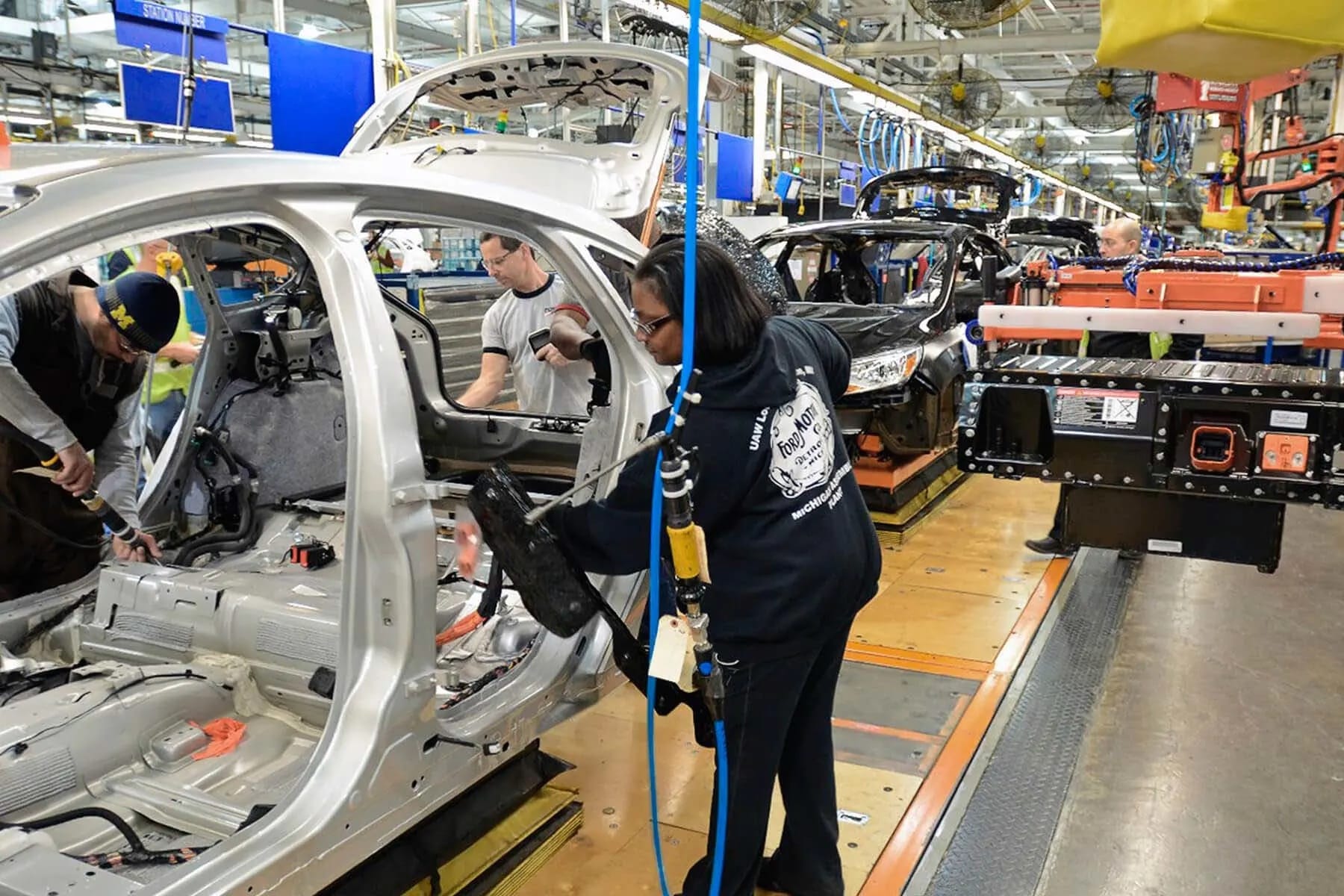
Before 3D printing, creating a physical prototype of a new component meant machining it from a block of metal or creating a temporary mold. Either approach took weeks and cost thousands of dollars per iteration. Engineers might get 2-3 prototype rounds before budget or schedule forced a decision.
With 3D printing in car manufacturing, the cycle looks completely different:
- Monday: Engineer finalizes CAD design
- Tuesday: Prototype printed overnight
- Wednesday: Team evaluates fit and ergonomics on the actual vehicle
- Thursday: Design revised based on feedback, second prototype printing
- Friday: Final validation complete
Ford prints tens of thousands of prototype parts annually. Their engineers can iterate 10+ times on a single component in the time it previously took to get one prototype back from a machine shop. The cost per iteration drops from $3,000-10,000 (CNC machining) to $50-500 (3D printing).
BMW uses large-format 3D printing to prototype full interior panels, checking how dashboard assemblies look and feel before investing in injection mold tooling that costs $50,000-200,000 per component.
This speed advantage compounds. When each design iteration takes days instead of weeks, engineers explore more options, catch problems earlier, and deliver better final designs. The cars you drive today are better because their components went through 5x more prototype rounds than previous generations.
Production Parts: 3D Printed Car Parts Already on the Road
Prototyping gets the headlines, but the real shift is 3D printed car parts going directly into production vehicles. These aren't concept pieces. They're components on cars you can buy at a dealership today.
Notable examples of 3D printing automotive parts in production:
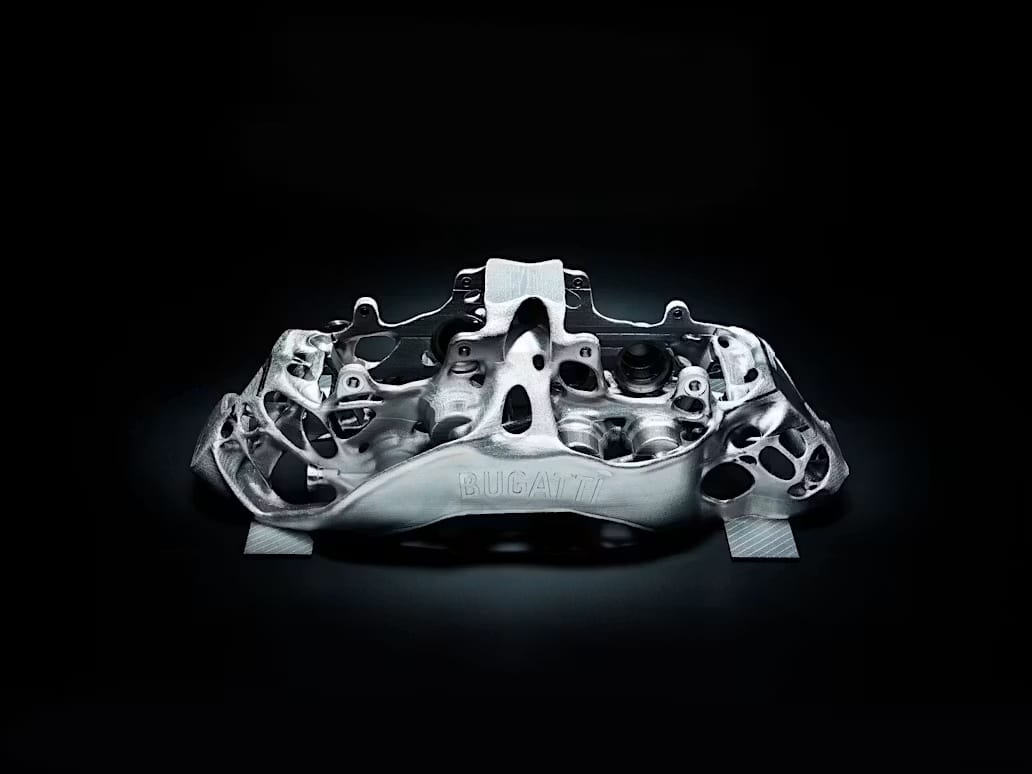
- Bugatti: Titanium brake calipers produced via metal 3D printing. 41% lighter than conventional calipers with no loss in braking performance. Each one contains internal cooling channels impossible to create with traditional casting.
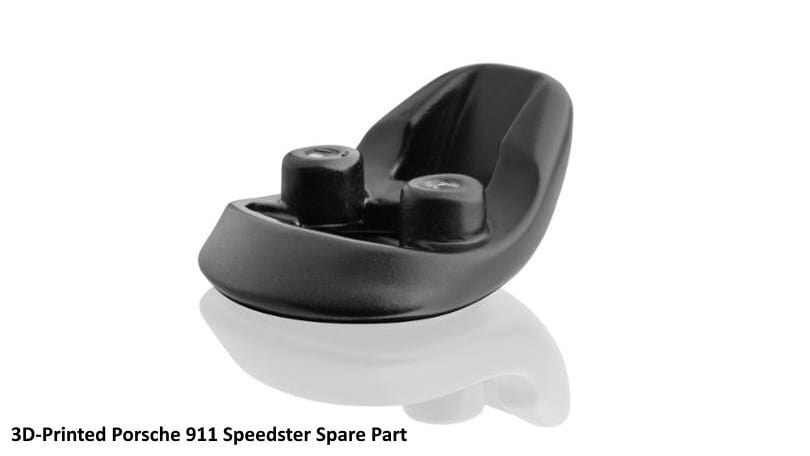
- Porsche: 3D printed pistons for the 911 GT2 RS. The internal lattice structure reduces weight by 10% while handling the same combustion pressures. Also prints replacement parts for classic 911s (pre-1990) where original tooling no longer exists.
- BMW: Roof brackets for the i8, window guide rails for the 3 Series, and dozens of interior metal components across their lineup. Over 300,000 3D printed parts on production BMWs so far.
- Rolls-Royce / Bentley: Interior trim pieces customized per customer order. When you're building 5,000 cars per year with nearly infinite configuration options, 3D printing each unique interior panel makes more economic sense than maintaining hundreds of mold variants.
Why does 3D printing work for these applications? They share common traits: low-to-medium volume, high geometric complexity, weight sensitivity, or customization requirements. A component that would require $80,000 in mold tooling for a 500-unit production run becomes economically viable at $150-800 per part with 3D printing.
Can You 3D Print an Entire Car?
The short answer: partially yes, fully no.
The first 3D printed car to drive on public roads was the Local Motors Strati in 2014. Its body and chassis were printed in 44 hours from carbon-fiber reinforced ABS on a large-format industrial printer. It demonstrated the concept but relied on conventional components for the drivetrain, suspension, electronics, and glass.
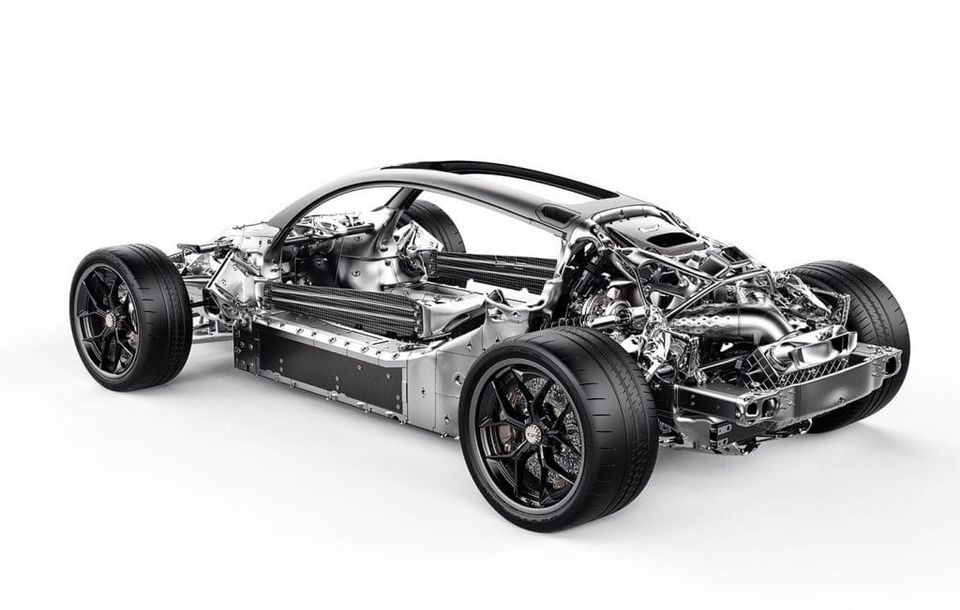
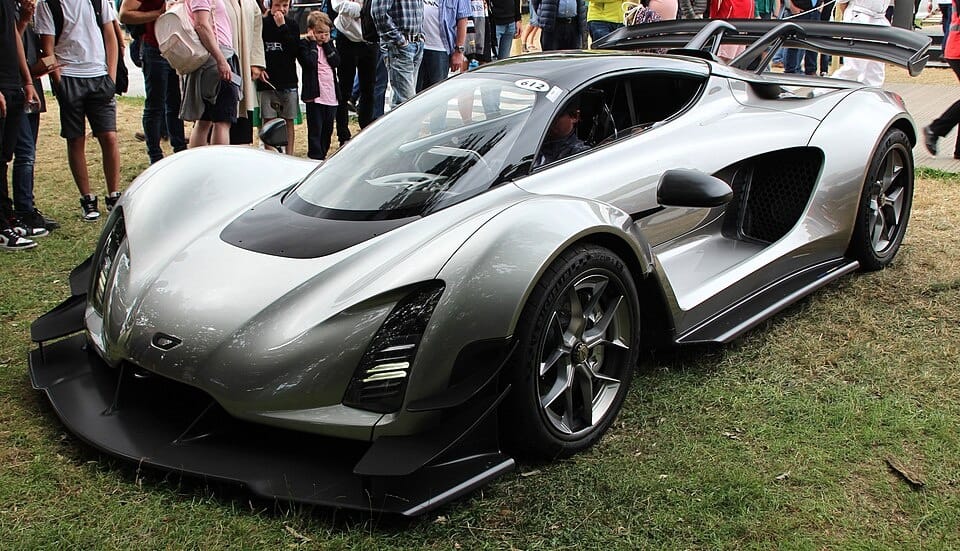
The most impressive 3D printed vehicle in 2026 is the CZINGER 21C, a $2 million hypercar that uses metal 3D printing for its entire chassis node structure. Divergent Technologies (Czinger's parent company) prints aluminum and titanium structural nodes, then connects them with carbon fiber tubes. The result: a 1,250-horsepower car weighing just 1,250 kg. The 3D printed chassis is lighter and stiffer than a conventional welded structure.
Other 3D printed vehicles include electric microcars, military utility vehicles, and autonomous delivery pods. The common thread: structural components and body panels are printed, while motors, batteries, electronics, suspension, glass, and tires come from traditional manufacturing.
Could you 3D print cars entirely? Not with current technology. Electric motors require precision copper windings. Batteries need electrochemistry. Glass is glass. But the percentage of a vehicle that can be additively manufactured keeps growing each year. Some estimates suggest 30-40% of a car's structural mass could be 3D printed by 2030.
3D Printable Car Parts You Can Make at Home
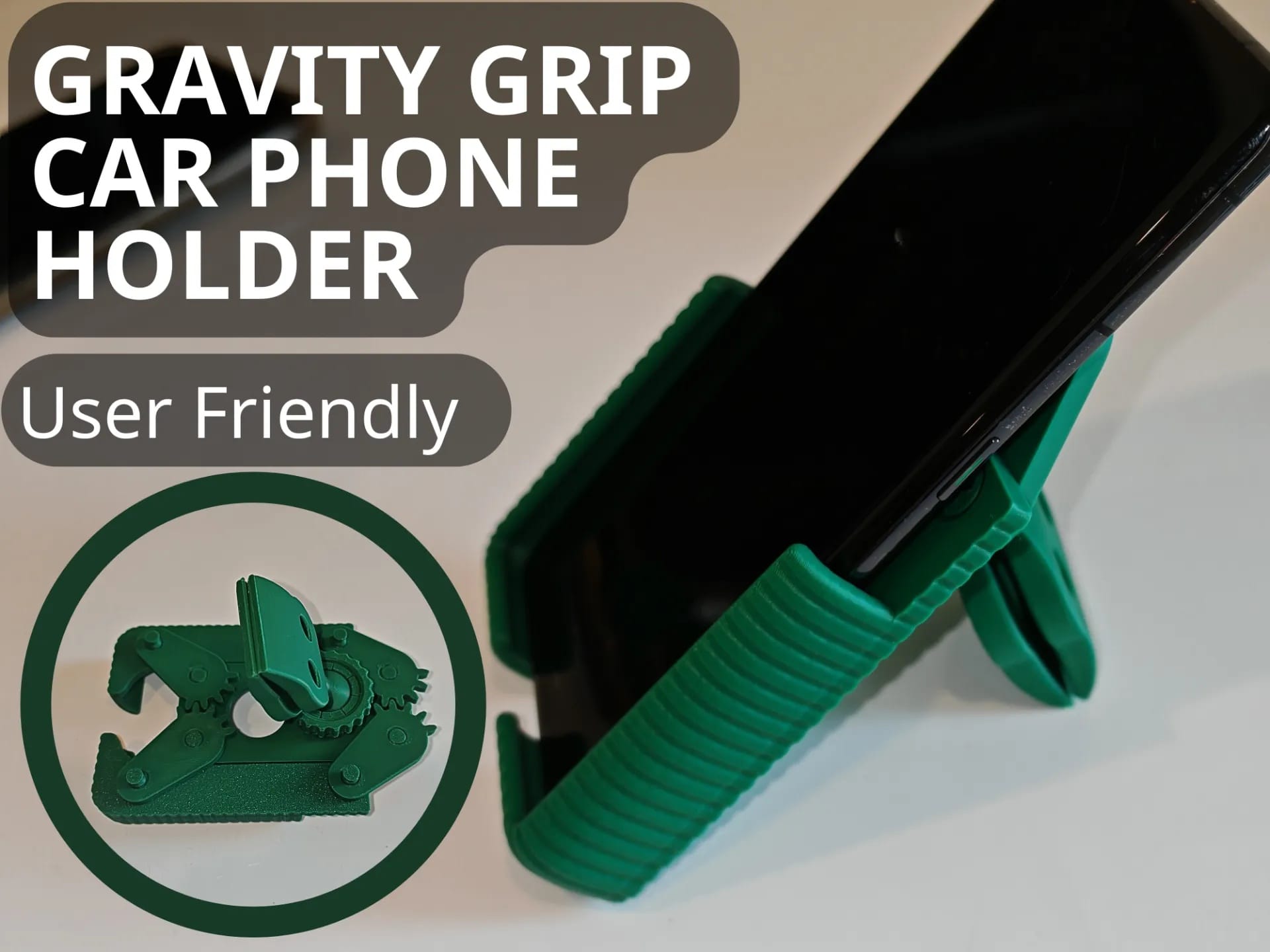
You don't need a factory-grade printer to benefit from 3D printing in cars. A desktop FDM printer ($300-600) can produce dozens of useful automotive parts, and communities on MakerWorld, Printables, and other model platforms host thousands of vehicle-specific designs.
Parts well-suited for desktop 3D printing:
- Phone and tablet mounts (vehicle-specific fitment)
- Cup holder adapters and inserts
- Air vent clips and accessories
- Cable management clips and OBD2 port holders
- Dashboard trim pieces and switch blanks
- Sun visor clips (a notoriously breakable OEM part)
- Trunk organizer dividers
- Key fob cases
- Replacement knobs (HVAC, radio, seat adjustment)
- License plate frames
Where to find designs:
Search your car's make and model on MakerWorld (makerworld.com) for the largest collection of community-designed car parts. Many designs are parametric, meaning you can adjust dimensions before downloading. MakerWorld also has a reward system where popular designers earn points, which incentivizes high-quality uploads with detailed fitment notes. If you can't find your specific vehicle on MakerWorld, try Printables or Thingiverse as secondary sources.
Material recommendations for 3D printable car parts:
- ASA or ABS: For anything exposed to sunlight or heat (dashboard, exterior). UV-resistant and handles 80-100°C without deforming
- PETG: Good all-rounder for interior parts. Tough, chemical-resistant, doesn't warp as much as ABS
- PA-CF (carbon fiber nylon): For structural clips and brackets that need real strength. Requires an enclosed printer with heated chamber
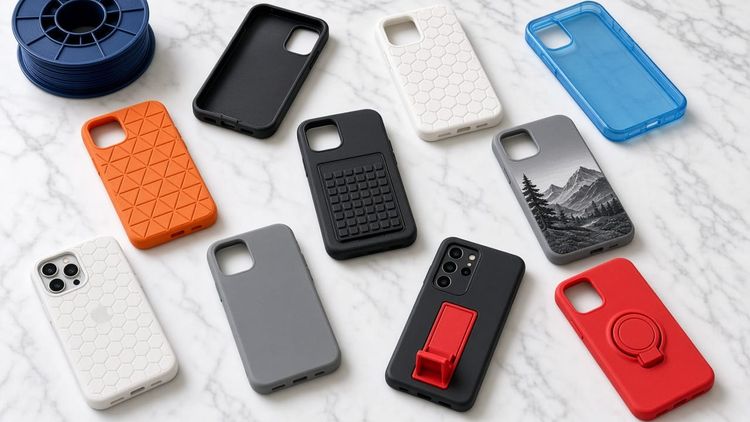
- TPU (flexible): Phone mount grips, vibration dampeners, gaskets
Important note: Only print non-safety, non-structural parts for road vehicles. Interior trim, organizers, mounts, and cosmetic pieces are fine. Never 3D print brake components, suspension links, steering parts, or anything where failure could cause an accident.
Where to Buy 3D Printed Auto Parts
Not everyone owns a printer. If you need 3D printing auto parts but don't want to invest in equipment, several options exist:
Online 3D printing services:
- JLCPCB / PCBWay: Upload a 3D model file, choose material, receive parts by mail in 3-7 days. Surprisingly affordable for one-off parts ($5-50 for typical car accessories)
- Xometry / Hubs: More materials and finish options, better for functional/structural parts
- Shapeways / Craftcloud: Marketplace model where you can also browse existing designs
Local options:
- Search "3D printing service" + your city. Many local makerspaces and print shops accept custom orders
- Some auto shops and car clubs have members with printers willing to print parts for fellow enthusiasts
- University makerspaces often offer printing services to the public at material cost
When to use a service vs. buy a printer:
- Need 1-3 parts? Service is cheaper
- Need parts regularly or want to iterate on fit? A printer pays for itself after 5-10 jobs
- Need exotic materials (metal, carbon fiber nylon)? Service, unless you own a high-end enclosed printer
How 3D Printing in Cars Affects Everyday Drivers
Even if you never touch a 3D printer yourself, 3D printing in cars is already affecting your ownership experience:
Discontinued parts get a second life. When a car is 15+ years old, manufacturers stop producing replacement parts. Traditional fix: scour junkyards or pay aftermarket premium. 3D printing fix: scan the broken part (or find the CAD file), print an exact replica. Porsche officially does this for their classic car program. Independent shops offer the same service for any make and model.
Customization without compromise. Want a phone mount that fits your exact dashboard contour? A gear shift knob with your preferred diameter and texture? A center console insert sized for your specific accessories? 3D printing makes one-off customization economically viable. No minimum order quantities, no mold fees.
Faster repairs, shorter wait times. Some dealerships are beginning to stock 3D printers for producing simple replacement parts on-demand rather than waiting for warehouse shipments. A cracked interior trim piece that takes 2 weeks to ship from a central warehouse can be printed overnight at the dealer.
Lighter cars, better efficiency. 3D printed parts using lattice structures and topology optimization weigh 20-40% less than conventionally manufactured equivalents. Applied across hundreds of components, this reduces vehicle weight, improving fuel economy for combustion engines and extending range for EVs.
Companies Leading 3D Printing in the Car Industry
The 3D automotive landscape includes both traditional automakers and specialized startups:
Established automakers:
- BMW Group: 1+ million 3D printed parts per year across prototyping, tooling, and production. Operates an Additive Manufacturing Campus in Munich with 50+ industrial printers
- Ford Motor Company: Pioneered automotive 3D printing in the 1990s. Uses it across prototyping, factory tooling, and F-150/Mustang custom accessories
- Porsche: Classic Parts program reproduces discontinued components. Also uses metal AM for high-performance engine parts
- General Motors: 3D printed tooling for Ultium EV battery platform. Thousands of assembly aids across their factories
- Mercedes-Benz / Daimler: Metal spare parts program for trucks and buses. On-demand production at regional depots
Specialized 3D printer automobile companies:
- Divergent Technologies / Czinger: Metal-printed chassis nodes for hypercars and potentially mass-market vehicles
- Local Motors (legacy): Demonstrated the first 3D printed car; technology lives on in autonomous shuttle designs
- Relativity Space: Primarily aerospace, but their large-format metal printing technology has automotive applications
- Desktop Metal / Markforged: Making metal 3D printing accessible to smaller automotive suppliers
The trend: every major automaker has moved from "experimenting with 3D printing" to "integrating it into standard workflows." The question isn't whether they use it, but how deeply.
Materials and Technologies Used in Automotive 3D Printing
Different automotive applications require different 3D printing technologies:
FDM/FFF (Fused Deposition Modeling):
- Used for: Prototypes, jigs, fixtures, interior trim, aftermarket parts
- Materials: ABS, Nylon, PC, PA-CF, PETG
- Why: Cheapest, fastest for large parts, wide material selection
- Desktop accessible: Yes (Bambu Lab, Prusa, etc.)
SLA/DLP (Resin):
- Used for: High-detail prototypes, validation models, small precision parts
- Materials: Standard resin, tough resin, heat-resistant resin
- Why: Best surface finish and dimensional accuracy
- Desktop accessible: Yes (Elegoo, Anycubic, Formlabs)
SLS (Selective Laser Sintering):
- Used for: Functional Nylon parts, under-hood components, production-ready pieces
- Materials: PA12, PA11, glass-filled Nylon, TPU
- Why: Isotropic strength, no support structures, production-ready
- Desktop accessible: Limited (Sinterit Lisa at ~$10,000)
Metal AM (DMLS/SLM/EBM):
- Used for: Structural components, brake parts, engine internals, chassis nodes
- Materials: Titanium, aluminum (AlSi10Mg), Inconel, stainless steel
- Why: Complex geometries impossible with casting, weight reduction through lattice structures
- Desktop accessible: No (industrial only, $100,000+)
3D printing in the automotive industry increasingly combines multiple technologies within a single vehicle program: FDM for factory tooling, SLA for design validation, SLS for functional testing, and metal AM for final production parts.
Limitations and Challenges of 3D Printing in Cars
Despite the progress, significant limitations remain:
Production speed. A single 3D printed part might take 4-20 hours. An injection mold produces the same part in 30 seconds. For components needed in volumes above 10,000-50,000 units, traditional manufacturing still wins on cost and throughput.
Safety certification. Brake calipers, structural members, and crash-relevant parts require extensive testing and certification. Each printed batch must prove consistency. The certification process for additively manufactured safety parts is still evolving and adds time and cost.
Surface finish. Most 3D printed parts require post-processing: sanding, painting, vapor smoothing, or machining contact surfaces. This adds labor and cost that chips away at the economic advantage.
Material limitations. Despite growing options, 3D printing can't match the full range of alloys, composites, and specialty materials available through traditional manufacturing. Certain automotive requirements (specific creep resistance, fatigue life, electrical conductivity) still demand conventional processes.
Size constraints. Most industrial printers max out at 300-600mm build volumes. Full body panels require either very large (expensive) printers or joining multiple printed sections.
Cost at scale. 3D printing is cheaper for 1-500 units. At 50,000+ units, injection molding, die casting, and stamping are significantly cheaper per part. The crossover point depends on part complexity and size.
The Future of 3D Printing in Cars (2026 and Beyond)
Several trends will accelerate 3D printing in cars over the next 5-10 years:
Digital spare parts libraries. Instead of warehousing physical inventory, manufacturers store CAD files. When a part is needed, it's printed on-demand at the nearest facility. No more "discontinued" parts. Every component ever designed remains available forever as a digital file.
EV platform adoption. Electric vehicles have fewer parts than combustion cars (roughly 20 vs. 2,000 moving parts in the drivetrain alone). The remaining parts are often novel designs without existing tooling, making 3D printing the fastest path from design to production.
AI-driven generative design. Software automatically generates optimized part geometries based on load requirements, then outputs shapes that only 3D printing can produce. Human designers specify the constraints; AI produces organic, topology-optimized structures that are lighter and stronger than anything a human would draw.
Multi-material printing. Printing parts that combine rigid and flexible zones, conductive and insulative regions, or metal and polymer sections in a single pass. This eliminates assembly steps and enables entirely new component designs.
Decentralized manufacturing. Regional micro-factories with banks of 3D printers producing parts on-demand, customized for the local market. Less shipping, less warehousing, faster delivery, lower carbon footprint.
The broader 3D printing innovations landscape is accelerating, and automotive is consistently the first traditional industry to adopt each new capability at scale.
FAQ
How much does it cost to 3D print a car?
A fully 3D printed concept car (body and structural components only) costs roughly $7,000-30,000 in materials and machine time, not counting the drivetrain, electronics, and assembly labor. The Czinger 21C hypercar, with its metal-printed chassis, sells for $2 million, but that includes extensive engineering and exotic materials. For practical purposes, 3D printing individual car parts ranges from $5 (a plastic clip on a desktop printer) to $5,000+ (a titanium structural component on an industrial metal printer).
Is it possible to 3D print a car?
Yes, with caveats. Multiple drivable 3D printed cars exist. The body panels, chassis nodes, and many structural components can be additively manufactured. However, motors, batteries, electronics, glass, tires, bearings, and suspension springs still require conventional manufacturing. Currently, 10-20% of a car's total parts can be 3D printed. That percentage is growing each year as materials and printer capabilities improve.
Is it legal to 3D print a car?
3D printing a car or car parts is legal in most countries. There are no laws against additive manufacturing itself. However, any vehicle driven on public roads must comply with local safety regulations (crash standards, emissions, lighting). 3D printed safety-critical parts (brakes, steering, structural) would need to pass the same certification as traditional parts. For DIY interior accessories, mounts, and non-structural trim, there are no regulatory concerns.
What are the limitations of 3D-printed cars?
The main limitations are: production speed (too slow for high volumes), material certification (safety parts need extensive testing), size restrictions (most printers can't do full body panels in one piece), cost at scale (injection molding wins above 10,000-50,000 units), and limited material options compared to the full range of automotive alloys and composites. 3D printing works best for low-volume, high-complexity, customized, or weight-critical applications rather than mass-market commodity parts.


Comments ()